Simplest dedicated gold setup
Minelab GOLD MONSTER 1000
Beginners who want automatic ground balance and a high-frequency VLF detector for small, shallow natural gold.
Gold detector guide · checked August 30, 2026
Choose the GOLD MONSTER 1000 for the simplest automatic VLF setup. Choose the Goldmaster 24K for more VLF control, or the Axiom Lite when severe mineralization calls for pulse induction.

The quick answer
Start with mineralization and target size. Features matter only after the detector can stay stable where you plan to search.
Simplest dedicated gold setup
Beginners who want automatic ground balance and a high-frequency VLF detector for small, shallow natural gold.
More adjustable VLF control
Prospectors who want 48 kHz sensitivity plus more control over changing mild-to-moderate mineralized ground.
Pulse induction for difficult ground
Prospectors working severely mineralized or salty ground where a pulse-induction detector earns its extra cost and learning curve.
Read the soil first
Mineralized soil can sound like a target. The harder the ground is for a detector to ignore, the more ground handling matters.
Mild to changing ground
A simple place to start when you want the detector to handle most setup work.
Choose: GOLD MONSTER 1000Mild to moderate mineralization
More controls help when the soil changes and you are willing to learn the ground response.
Choose: Goldmaster 24KSevere mineralization or salty ground
PI handles very difficult ground well, but costs more and gives less target information.
Choose: Axiom LiteSide-by-side
A high frequency can help with small gold. Ground handling, coil size, and a stable sweep still decide whether that sensitivity is useful.
| What matters | MinelabGOLD MONSTER 1000 | GarrettGoldmaster 24K | GarrettAxiom Lite |
|---|---|---|---|
| Detector type | 45 kHz VLF | 48 kHz VLF | Pulse induction with advanced pulse timings |
| Ground and signal controls | Gold Chance indicator; auto or manual sensitivity; auto noise cancel | 0–99 target ID; XGB, Ground-Sync, TracLock, and SAT control | Dual ground balance; 4 ground-track speeds; PWM or VCO audio |
| Search modes | Gold, Deep All Metal | All-metal prospecting with VCO or 2-tone beep audio | Fine, Normal, Large, Salt |
| Included coil | GM05 5 in round Double-D, waterproof | 6 × 10 in DD, waterproof | 11 × 7 in mono search coil |
| Weight | 2.94 lb / 1.33 kg | About 3.0–3.4 lb / 1.36–1.54 kg | 4.2 lb / 1.9 kg with 11 in mono coil and cover |
| Water limit | Coil to 3.3 ft / 1 m; control box is splash- and rainproof | Waterproof search coil; keep the control box dry | Waterproof coil and stem; rainproof control box |
| Power | Rechargeable battery pack or 8 AA battery adapter | 8 AA batteries | Built-in rechargeable lithium-ion battery |
| Warranty | 2 years for control box and coil | 3-year warranty | 3-year warranty |
Minelab
Garrett
Garrett
Manufacturer specifications translated into plain English and checked on August 30, 2026. Price, stock, battery runtime, and one-size-fits-all depth claims are left out.
The full shortlist
Each pick has a useful job and an honest catch. The original manufacturer pages are collected in Sources near the end.
Simplest dedicated gold setup
Beginners who want automatic ground balance and a high-frequency VLF detector for small, shallow natural gold.
Automatic ground balance, sensitivity, and noise cancel reduce the setup work, while 45 kHz VLF stays sensitive to small gold.
The coil is waterproof to 3.3 ft / 1 m. The control box is rainproof, not submersible.
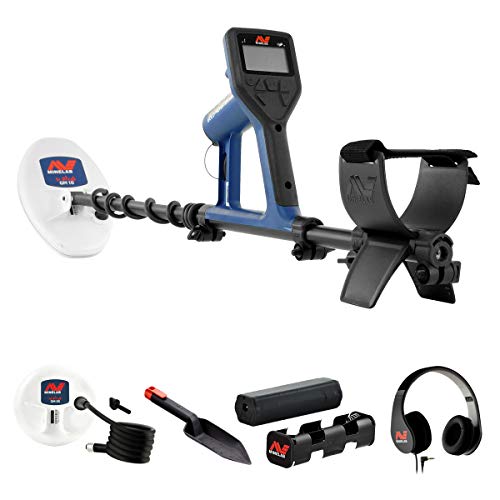
Amazon package shown: GOLD MONSTER 1000 with two search coils.
More adjustable VLF control
Prospectors who want 48 kHz sensitivity plus more control over changing mild-to-moderate mineralized ground.
XGB automatic ground balance, manual Ground-Sync, TracLock, SAT control, and a 0–99 target ID give the operator more ways to tune the detector.
The search coil is waterproof, but the control box must stay out of the water.
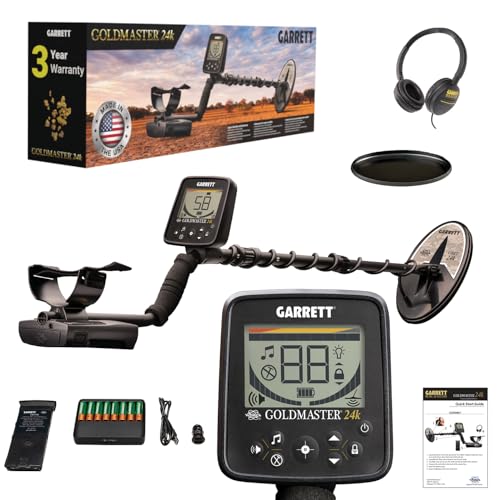
Amazon package shown: Goldmaster 24K with wired headphones.
Pulse induction for difficult ground
Prospectors working severely mineralized or salty ground where a pulse-induction detector earns its extra cost and learning curve.
Pulse induction, dual-channel ground balance, and four ground-track speeds are designed for mineralization that can make a high-frequency VLF detector noisy.
The included mono coil cannot use Iron Check; that feature needs a compatible DD coil. The control box is rainproof, not submersible.
Five-minute decision
A good detector is not a map to gold. Start with legal gold-bearing ground, then match the machine to its soil.
Check land status, mining claims, local rules, and reliable geological records before you swing.
Mild ground suits VLF. Severe iron or salt mineralization can make PI worth the extra cost.
A high-frequency VLF and a smaller coil are useful when small targets matter most.
Automatic setup gets you moving. Manual control gives you more ways to calm changing ground.
Include the detector, spare power, headphones, scoop, water, safety gear, and the walk back.
How we chose
Buyer FAQ
There is no single winner for every goldfield. The GOLD MONSTER 1000 is the simple automatic VLF pick. The Goldmaster 24K gives you more VLF control. The Axiom Lite is the pulse-induction pick for severely mineralized ground.
Yes, if the gold is large enough and the detector can stay stable in that soil. A coin detector may find a gold ring or a larger nugget, but a dedicated prospecting detector is usually more sensitive to small natural gold and difficult ground.
A high-frequency VLF detector is a strong first choice for small, shallow nuggets in mild-to-moderate ground. Pulse induction usually handles severe mineralization better, but it costs more and gives less target information.
Higher VLF frequencies such as 45 or 48 kHz can respond well to small gold. Frequency is only one part of the answer: ground balance, coil size, mineralization, and careful sweep control also matter.
There is no honest universal depth number. Nugget size, shape, position, ground mineralization, coil size, detector setup, and electrical noise all change the result.
A larger flake can give a signal at close range. Fine gold dust is usually too small to create a useful standalone signal, so a detector is not a replacement for panning or other fine-gold recovery methods.
Official product sources
Last source review: August 30, 2026. These manufacturer pages support the detector specifications and water limits above. Current offers and availability stay on Amazon.