Before the tree
Record what the database cannot see.
- 01JurisdictionCountry and legal route
- 02Both facesStraight, sharp photographs
- 03EdgePlain, reeded, lettered, cut
- 04DiameterWidest point in millimeters
- 05WeightGrams, without scraping
- 06LettersCopy only what is visible
- 07ContextDepth and private location
The visual decision tree
Five clues, in the right order.
- 01Choose a broad materialSurface color can lie after burial
Gold-coloredDo not scratch-test Silver-coloredCould include low-silver billon Copper alloyBrown, green, or black surface Mixed gray-bronzeTry overlapping database filters ?UnsureKeep several materials selected Possible matchLater Roman “silver” pieces can be billon—a copper-rich alloy with a little silver—or bronze with only a small amount of silver. OCRE recommends trying more than one material when uncertain.
Confirm it with the other face, letters, size, weight, and an official database. - 02Measure the widest diameterAE means copper alloy; these labels are size bands, not exact coin names
AE1More than 25 mm AE219–25 mm AE314–18 mm AE4About 5–14 mm AE4 minimUnder 5 mm Possible matchA worn or clipped piece can be smaller than it was when struck. Keep the measured size as evidence; do not force it into a denomination.
Confirm it with the other face, letters, size, weight, and an official database. - 03Study the portrait and headwearChoose the closest visible shape
These are real Roman coins. Use them to compare broad shapes—not to force an exact emperor match. Photo credits
Bare or laureateNo headwear—or a tied leaf wreath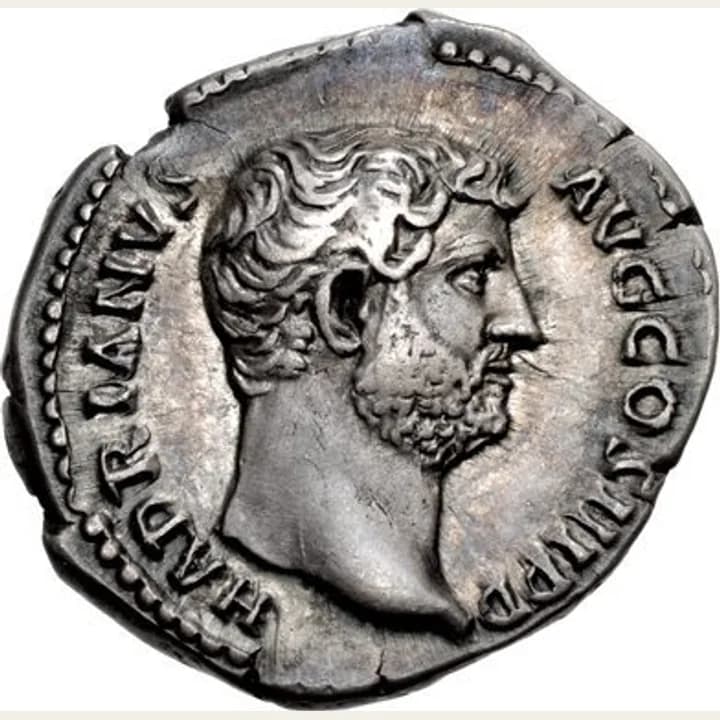
Bare 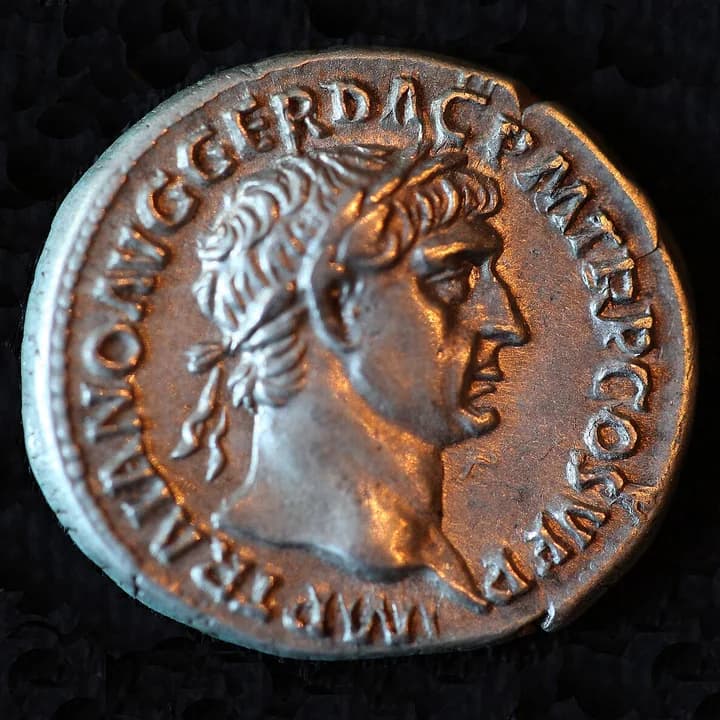
Laureate Radiate crownStraight sun rays around the head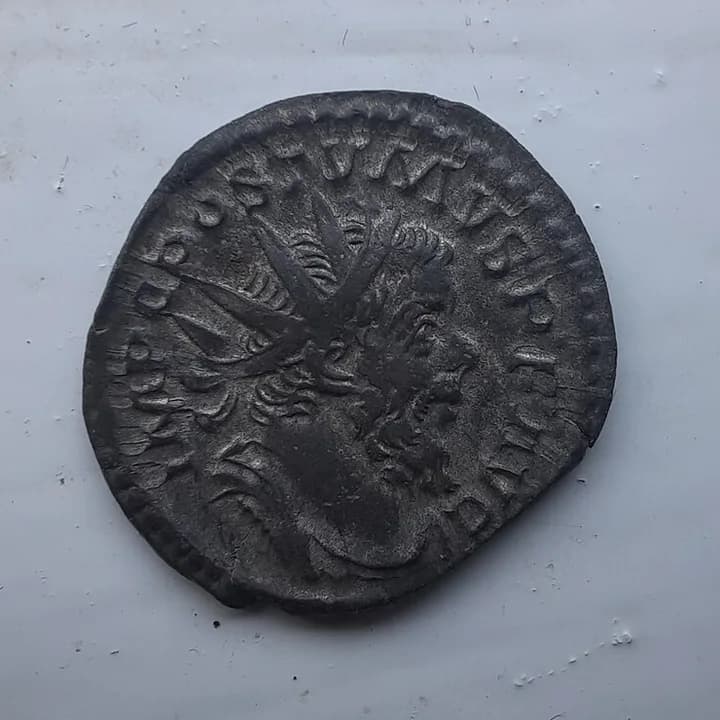
Radiate Pearl diademA narrow band made from small beads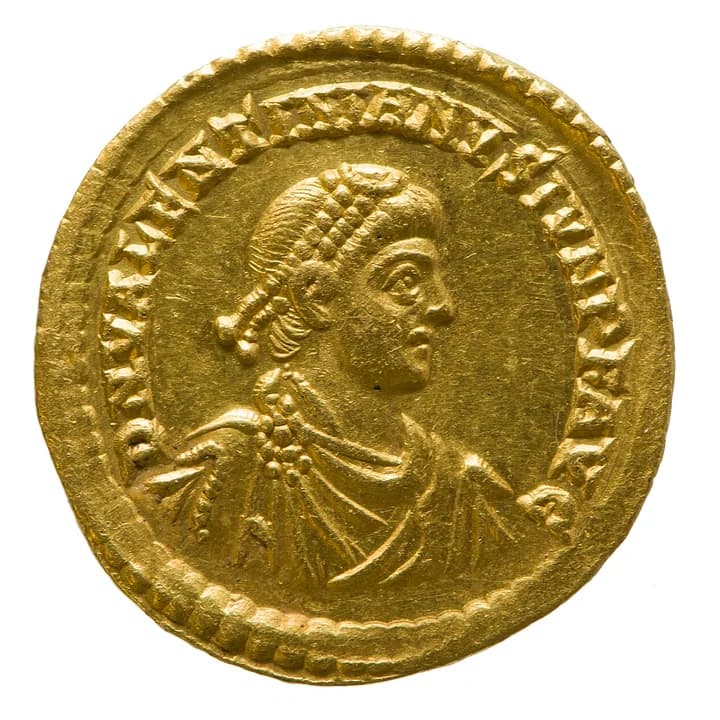
Pearl band HelmetA hard cap, often with a crest or plume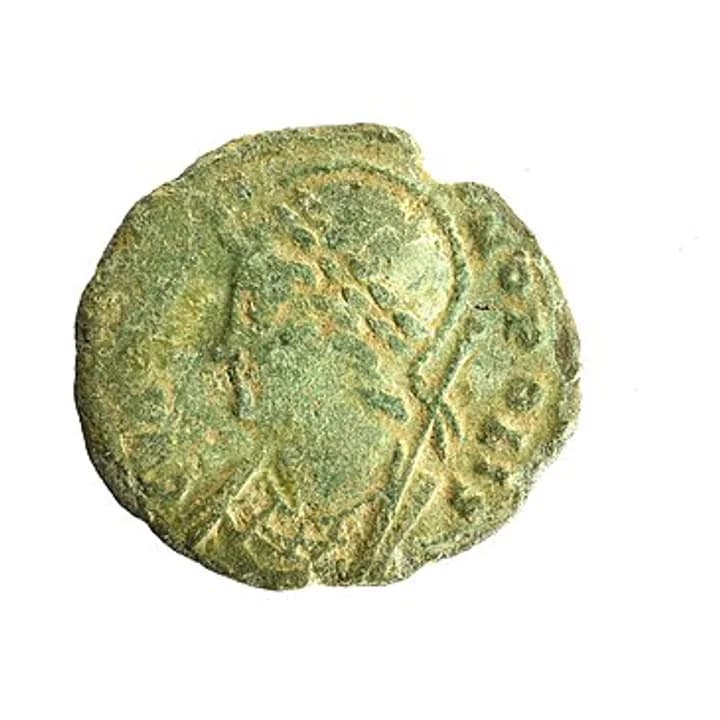
Helmet Two portraitsRecord both people and which way they face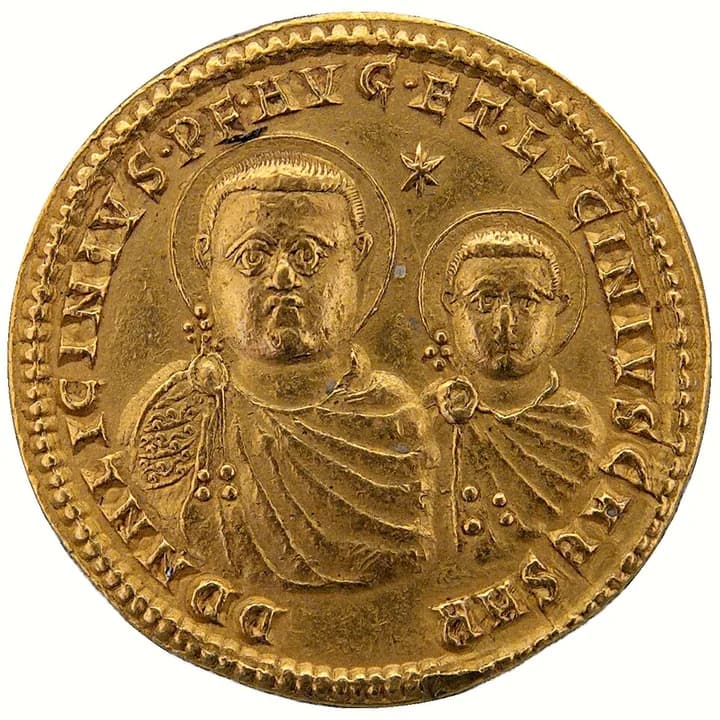
Two people No portrait visibleDo not guess—use letters, size, and reverse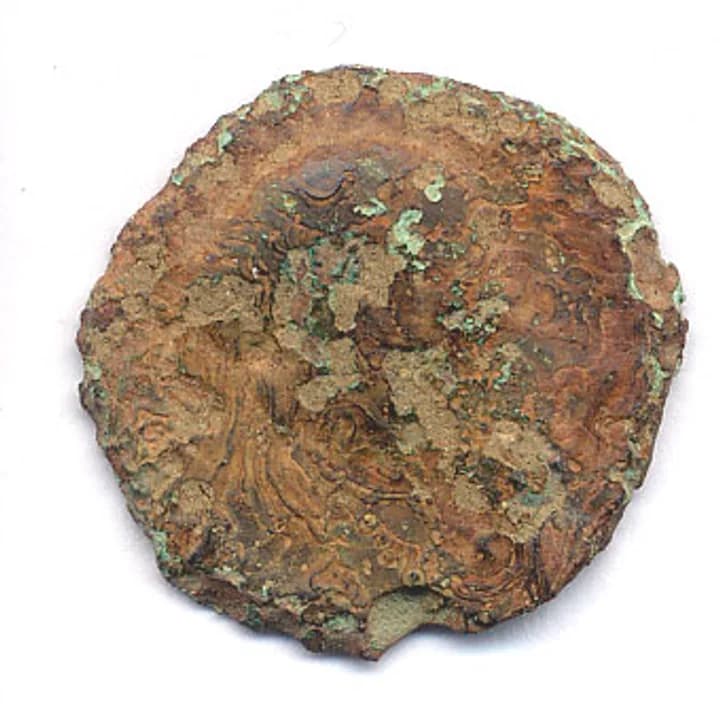
Too worn Possible matchA crown with sun rays is a radiate clue. It narrows the search, but many rulers and irregular copies used this form.
Confirm it with the other face, letters, size, weight, and an official database.Photo credits and reuse licenses
Each photo links to its Wikimedia Commons file page. We cropped each image for easier comparison; the credits and reuse licenses are listed below. No find coordinates are republished here. Open the attribution file.
- Hadrian denarius, obverse Photo: Classical Numismatic Group, Inc., via Wikimedia Commons · CC BY-SA 2.5 · source file cropped on Wikimedia Commons.
- Trajan denarius, obverse Photo: James Grout / Encyclopaedia Romana, via Wikimedia Commons · CC BY-SA 3.0 · cropped.
- Antoninianus of Postumus, obverse Photo: MumblerJamie, via Wikimedia Commons · CC BY-SA 2.0 · cropped.
- Solidus of Valentinian II, obverse Photo: York Museums Trust Staff / York Museums Trust (Yorkshire Museum), via Wikimedia Commons · CC BY-SA 4.0 · cropped.
- Constantinople Commemorative coin Photo: The Portable Antiquities Scheme / Rod Trevaskus, via Wikimedia Commons · CC BY 2.0 · obverse cropped.
- Licinius father-and-son gold multiple Photo: Photo: Marie-Lan Nguyen · Musée de la BnF, Beistegui 232, via Wikimedia Commons · Public Domain Mark 1.0 · cropped.
- Illegible Roman coin obverse Photo: Colchester Museums / Caroline McDonald; The Portable Antiquities Scheme / The Trustees of the British Museum, via Wikimedia Commons · CC BY-SA 4.0 · cropped.
- 04Copy only the letters you seeNever complete a ruler’s name from memory
Write gaps as gaps. In OCRE, remove spaces and punctuation and use an asterisk for missing text.
*CONSTANTINVS*This searches legends containing CONSTANTINVS with unreadable letters before or after it. - 05Describe the reverseCount people, objects, symbols, and letters
- Copy letters below the main image: this area is the exergue.
- Record symbols on the left and right.
- Note which way every person or animal faces.
- Count figures, standards, stars, dots, or pellets.
Possible matchOCRE can combine the reverse description with portrait, letters, material, date range, and mint. Compare your measured size separately. A picture match alone is not enough.
Confirm it with the other face, letters, size, weight, and an official database.
.jpg)


_obverse.jpg)
.jpg)

.jpg)
Portrait timeline
An orientation tool—not proof.
Co-emperors and regional issues overlap. Use this strip to find the right part of OCRE, then compare all the recorded clues.
Augustus to Nero
Vespasian, Titus, Domitian
Nerva to Commodus
Septimius Severus and family
Many short reigns and copies
Diocletian and colleagues
Constantine and family
Valentinian and Theodosian rulers
Later imperial issues to Zeno
Lookalikes and limits
“Not in OCRE” does not mean “not old.”
OCRE covers Roman imperial coin types from Augustus in 31 BC through Zeno in AD 491. It is not a database of every Greek, provincial, Celtic, Byzantine, medieval, or modern coin.
Country action panel
The find’s country chooses the next step.
England
Ask a Finds Liaison Officer.
Report suspected Treasure within 14 days. Important non-Treasure finds can still be recorded through PAS.
Open the England reporting routeNetherlands
Record it with RCE or PAN.
Report archaeological detector finds. If several objects appear together, stop and contact the municipality.
Open the Netherlands reporting routeAnother country
Start the legal route again.
Do not copy English or Dutch rules across a border. Keep the find and coordinates secure and contact the relevant national or regional heritage authority.
Return to the Europe guide